A fantasy map maker can create a coastline in seconds, but a coastline becomes memorable when readers can talk about it. Names let a player ask for the road to Bellwater, let a novelist connect two distant chapters, and let a cartographer decide which information deserves space on a small image. Good names therefore solve practical problems as well as adding atmosphere. They need to be recognizable, pronounceable enough for their audience, and consistent with the history you actually want to tell.
This guide follows a fictional region called the Reed Coast. It has a river port, an old watchtower, a farming valley, and three offshore islands. Rather than inventing a complete language, we will give those places a naming system that can expand when the story does. Start with a map from the fantasy map maker, then keep a separate naming sheet beside it. The sheet becomes the record of your decisions; the map stays readable.
Choose names for the people using the map
Your first naming constraint is the audience. A private setting notebook can contain long ceremonial titles and several historical spellings. A tabletop handout has to work when someone reads it across a crowded table. A book map might need to remain legible after it is reduced to a single paperback page. These uses do not require identical labels. Decide which version you are preparing before you fill the coastline with text.
For a campaign, read each major settlement name aloud once and imagine a player repeating it after an hour. If Bellwater and Bellwatch are both important, the shared beginning may cause confusion. Rename one, or use a clear spoken nickname such as the Watch. For a novel, check the name against character names too. A town called Maren can be awkward when the protagonist is Mara and a neighboring kingdom is Mareth. Similarity should serve a relationship, not happen accidentally.
Separate physical names from political names
Different groups name different things for different reasons. Sailors may call a dangerous headland the Broken Tooth because of its shape. An administration may record it as East Beacon Point. Farmers may preserve an older word for the whole ridge. These layers make a place feel lived in, but the public map does not need to display every layer at once. Choose one main label and record alternatives in the notebook.
On the Reed Coast, the physical region is Reedwater Marsh. The kingdom is the March of Halden. Those names describe different boundaries: the marsh follows wet ground, while the march follows an agreement between rulers. Keeping the distinction prevents political labels from replacing all geographic identity. When Halden loses a town, the river can keep its old name. See political kingdoms and map boundaries for ways to separate territory from terrain.
Build a small sound palette
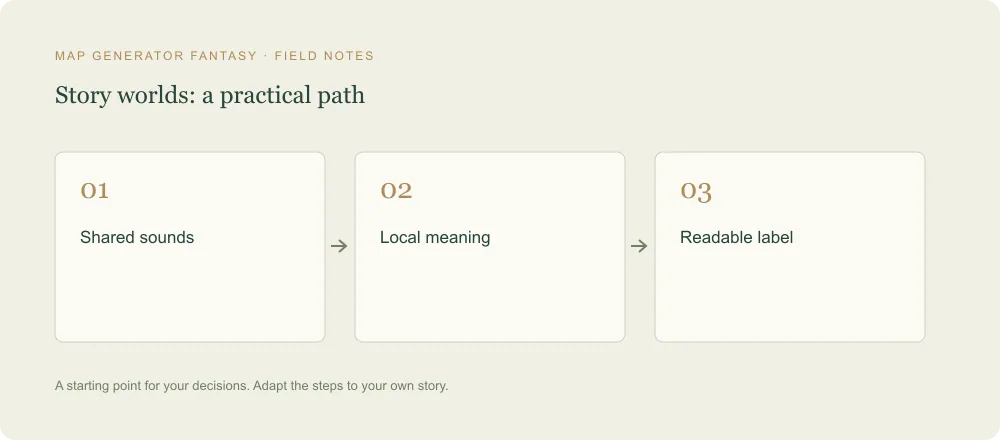
A sound palette is a short list of recurring sounds, not a claim that you have constructed a real language. For the coastal culture, choose soft consonants and broad vowels: m, l, r, v, a, e, and o. For the inland administration, choose shorter, firmer combinations: hal, dun, ket, and tor. You can create contrast with only a handful of ingredients. Write examples beside the palette so future names follow the same pattern.
Avoid making every name a minor variation of one root. Lamera, Lamero, Lamira, and Lamerael may look coherent on a list but become difficult to distinguish in conversation. Vary length, first letter, and rhythm. Bellwater has three obvious beats; Varo has two; Old Tor has two short words. A mixed rhythm makes the map easier to scan while a restrained sound palette keeps the region connected. Test the list together instead of judging each name in isolation.
Give important names an underlying reason
A useful name can begin with an ordinary observation. The river port has a bell that warns boats about a rising tide, so its common name becomes Bellwater. The watchtower overlooks a pale stone quarry, so travelers call it White Watch. The farming valley is sheltered from coastal wind, making Stillfold a reasonable local nickname. These origins give you story details without requiring a paragraph of invented etymology for every label.
Keep the origin separate from the final spelling. A name that began as a description may become shorter through everyday use. Broken Tooth could be called the Tooth by sailors, while an official map retains the full phrase. Do not assign a false translation from an actual language merely because a word sounds appropriate. If you use a real linguistic source, verify its meaning and cultural context. Fictional roots can remain explicitly fictional and still feel convincing.
Use name families sparingly
Recurring suffixes can signal a history of settlement. Three towns built around river crossings might end in ford, while coastal villages use haven or quay. That pattern tells a reader something about their function. It works best when exceptions have a reason. Bellwater could be older than the newer Harrowford and Greenford, so its different ending becomes evidence of an earlier settlement phase rather than an inconsistency you need to erase.
Choose one or two visible families for each region. A map where every settlement ends in the same suffix can feel manufactured, and the labels may become hard to remember. Reserve a distinctive family for a particular institution, migration, or landscape. Forts founded by the same order might all include Watch. Nearby independent villages can keep unrelated local names. Connect this decision to where cities belong on a fantasy map, because the function of a place often explains its name.
Match label length to map hierarchy
Continents, realms, regions, settlements, and individual landmarks compete for different amounts of space. A realm name can stretch across a large area. A town name sits beside a small marker and must avoid neighboring labels. A very long landmark name can crowd out a river or coastline. Decide the hierarchy before you edit, then give each level an appropriate amount of text. Bigger significance does not always mean a longer name.
For the Reed Coast, use Halden as the main realm label, Bellwater for the port, and White Watch for the tower. Keep the ceremonial Kingdom of the Eastern Reed Marches in the notebook or article text. If you need the complete title on a presentation map, place it in an open area rather than squeezing it beside a city. The label typography guide explains how spacing and contrast support this hierarchy without making every label larger.
Name groups and individual places differently
An archipelago needs two naming levels: the group and its members. On our coast, the Three Lanterns are a group named for their navigation beacons. The individual islands are Lorn, East Lantern, and Gull Rest. A group label helps the reader locate the chain quickly, while island names support specific journeys. You can leave minor rocks unnamed until the story needs them. Blank space is useful room for future events.
Do the same for mountain systems and forests. The Greyback Range can contain the narrow pass called Crow Gate. The Reedwood can contain an abandoned road known as the King's Track. The broad name belongs on a regional map; the small feature may belong only on a local version. If you are making a nautical setting, archipelago geography offers a framework for deciding which islands need individual identity and which can remain a distant silhouette.
Create a compact name register
Keep a table or plain text list with five fields: map label, feature type, region, spoken form, and reason. Bellwater is a port in Halden, pronounced exactly as written, named for its warning bell. Lorn is an island in the Three Lanterns, with no extra pronunciation note needed. The register should help you use names consistently, not become a second project that consumes all your worldbuilding time.
Add aliases only where they change how people understand the setting. A ruined fortress might be Old Watch to villagers and North Garrison in an official record. Mark which version appears on each map. When you rename a place, update the register, chapter notes, campaign notes, and exported files together. A single source of truth prevents a later revision from accidentally creating two towns with different spellings of the same intended name.
Use generated suggestions as a starting list
If the blank page is slowing you down, open the fantasy name generator and collect a short list of suggestions. Select for rhythm and fit, then change the results to match your register. A generated name is useful raw material; it does not arrive with a verified history, translation, or guarantee that nobody else has used a similar word. Those decisions remain part of the author's work.
Generate for a specific feature rather than asking for a hundred unrelated names. Eight coastal town suggestions are easier to evaluate against Bellwater than a huge mixed list of people, kingdoms, and mountains. Reject names that duplicate a first syllable already used by a major place. Keep perhaps three finalists, say them aloud, and place them temporarily on the map. Their real test is how they behave beside existing labels and within a sentence.
Rename places without losing a useful map
Before editing many labels, export an editable JSON file from the generator. That file stores the map settings and supported edits, giving you a recoverable version if a naming experiment fails. A picture export is useful for comparison but cannot replace the editable file. Keep version names descriptive, such as reed-coast-names-v2, and avoid overwriting your only copy while you compare different naming systems.
Change the most important places first: the starting town, capital, main river, and destination of the next journey. Then inspect collisions at the size your audience will actually see. Move crowded labels where the editing controls allow it, or shorten the wording. Follow saving an editable map for the recovery workflow and the export guide when you are ready to create the public image.
Build a shortlist before labeling the map
Use the fantasy name tool to test a sound family before committing to your map labels. For a coastal region, choose Coastal and flowing, generate town names, and compare three candidates in spoken directions. Keep a short label on the map and a longer local explanation in your notebook. The tool supplies a shortlist rather than naming the entire setting for you. You can download the notes, then edit individual labels directly in the map generator.
Test names in scenes and conversation
Write three ordinary sentences using the major labels. “The ferry leaves Bellwater before dawn.” “A storm has damaged the beacon on Lorn.” “The patrol waits at White Watch.” These sentences expose awkward repetition and difficult rhythms more clearly than a list does. For a game, ask another person to point to each named place after you say it once. Their hesitation is useful feedback about clarity, not a failure of creativity.
Finally, check the complete map in miniature. You should be able to recognize the important names without reading every detail. If all labels have the same visual weight, fix hierarchy before inventing more words. If two places keep being confused, give one a distinct beginning or common nickname. A finished naming system is one that supports the story and can accommodate the next village you need, without forcing you to rebuild every name already on the coast.
Give the idea a world of its own.
Try the technique in the generator, then save an editable copy so you can return to your work.
Open the map maker ↗