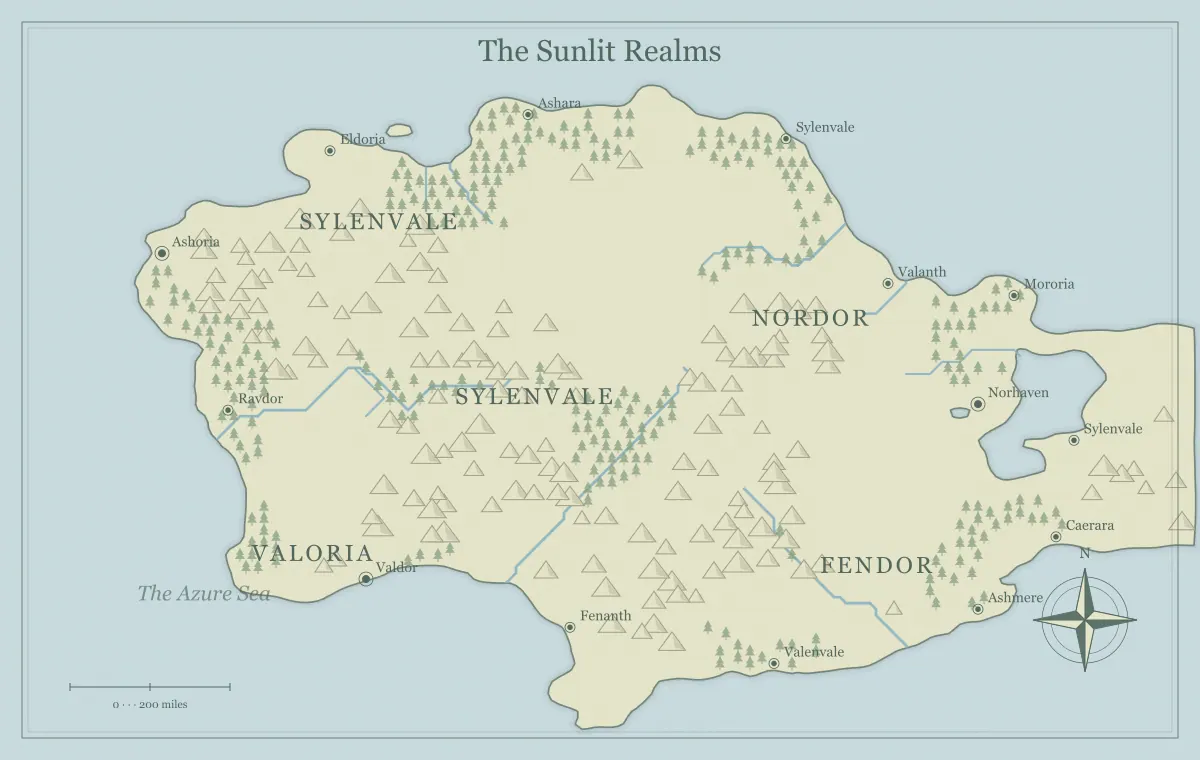
Magical geography can make a fantasy world distinctive when its effects have understandable relationships. A protected growing valley, a shifting entrance, or an unusual transport connection can influence settlement, supply, and authority. The feature becomes harder to use if it changes without explanation whenever the story needs a shortcut. A coherent magical place has a defined effect, a scope, and consequences that people in the world can learn and respond to.
This guide develops an original region called the Glasswind Basin using the fantasy map maker. The generator provides fictional geographic illustration and supported labels or landmarks, not a magical-system simulator. Your notes establish the unusual rules, and the map identifies their relevant places. We will define three features, connect them to ordinary needs, and decide which information belongs on a public overview.
Establish the ordinary setting first
Choose the broad geography and dependencies before adding exceptions. Glasswind has a coastal settlement, an inland basin, and a ridge crossing. The inland market needs a reliable water connection, while the coast supplies tools and repair materials. Those ordinary relationships give the magical features something to affect. Without a baseline, it becomes difficult to explain why an exception matters.
The settlement guide, river guide, and trade guide develop those connections. You can keep the baseline broad rather than scientifically exhaustive. The purpose is a setting whose important needs and routes are clear enough to reveal the consequences of magic.
Describe the effect in concrete terms
Write what the magic changes. Glasswind's protected valley supports a growing season different from the surrounding basin. A ridge gate creates a limited transport connection. A concealed spring entrance changes who can find a water site. These are different effects, so define them separately rather than using one vague statement that the whole region is magical.
Keep the description specific enough to guide a scene. Does the gate move people, goods, information, or all three? Does concealment affect sight or route access? The hidden realm guide separates unknown, concealed, and inaccessible places. A clear effect lets the audience reason about possibilities without needing every technical detail of the system.
Define where and when the effect applies
A magical feature needs a scope. The protected valley does not automatically change the climate of the entire basin. The gate connects two established sites under particular conditions. The concealed entrance affects one approach rather than erasing every record of the spring. Decide the boundary and duration that matter to the project.
The map can identify the site while the notes explain its scope. If you need a custom zone overlay, use an appropriate external layout or vector workflow; the current browser editor does not provide unrestricted magical-region painting. The climate guide distinguishes regional patterns from limited exceptions, and boundaries helps clarify what a drawn line means.
Choose limits that create meaningful decisions
A gate might operate only during established periods, carry limited loads, or require cooperation from people at both ends. A protected valley might depend on maintenance and a local resource. Those limits should create understandable choices rather than arbitrary refusals. Decide what users can know before relying on the feature and what uncertainty remains.
You do not need a numerical rule for every limitation. A qualitative condition can work if applied consistently. The route guide compares services, effort, and uncertainty. A magical connection can be one option in that network rather than a universal solution that makes every other route irrelevant.
Decide what sustains the feature
Choose the support the effect depends on: labor, materials, an institution, an agreement, or a defined magical source. Glasswind's protected valley requires regular work by a local group and supplies from the market. That dependency gives the place a relationship to the wider region. It also explains why people care about access and maintenance.
Record who performs the work and what happens if support is interrupted. Avoid inventing a new requirement only after the audience makes a plan. The faction guide connects assets and goals, while kingdom design links institutions to supply. Magical infrastructure can create ordinary political questions as well as exceptional scenes.
Follow the consequences for settlement
A reliable magical resource can attract people, but decide what else the settlement needs. A protected growing area still has relationships with tools, transport, storage, and neighboring communities under your fictional assumptions. A gate town may become a transfer center rather than a place that produces everything locally. Follow the actual effect without granting unrelated advantages automatically.
The city placement guide helps establish function and dependencies. Glasswind's inland market uses the protected valley's output but still needs coastal services. This keeps the setting connected. If the magic replaces a major ordinary need, record that explicitly and consider what changes for the routes and institutions built around the earlier dependency.
Keep magical travel consistent with the route network
The ridge gate can shorten one connection without making every journey instantaneous. Define its endpoints and the conditions of use. Travelers may still need to reach a gate site, wait, obtain access, or arrange onward transport. Those practical stages can preserve meaningful geography while giving the magical feature a distinctive role.
The scale guide separates distance from elapsed time, and journey planning connects routes to narrative choices. A character using the gate can meet different people or accept different obligations from one taking the pass road. The exception should change decisions rather than simply repair an inconvenient timeline whenever needed.
Trace effects on goods and exchange
If magic changes production or transport, decide who benefits and which dependency remains. The protected valley may provide a valued supply, while the gate may reduce one transfer delay. The market still needs handling space and agreements. A feature that supports trade can create influence without making its operators rulers of the whole region.
The trade guide provides a small network model. Test a shipment through the magical connection using the same limits you apply to characters. If heavy cargo follows different rules, establish those rules clearly. Consistency matters more than a complex system whose conditions change silently between scenes.
Decide what the audience can learn
Residents may understand routine operation while outsiders know only a broad reputation. A public chart can mark the gate without explaining private maintenance details. The concealed spring may be rumored without a precise location. Keep the knowledge states separate so discovery has a coherent path and the map does not expose every prepared secret.
The audience version guide provides an information inventory. For a novel, use the same method for author and reader views. A mysterious feature can still offer stable facts that support decisions. Complete uncertainty is not the only way to preserve wonder; selective knowledge lets people investigate and change their understanding.
Define failure through the established mechanism
A failure should reflect what sustains the effect. If maintenance stops, the protected valley may lose a particular benefit under your chosen rules. If cooperation at one gate endpoint breaks down, the connection may become unavailable. Specify what changes and what remains. Do not treat every failure as a reason for unrelated terrain to transform unless the system establishes that consequence.
A failure can create several responses: repair support, alternative transport, negotiation, or adaptation. The sandbox guide connects situations to choices without forcing one solution. Make the practical evidence available so the audience can understand the problem rather than guessing which new rule the story has introduced.
Give magical places a history with present consequences
A feature may have been created for one purpose and now serve another. Glasswind's gate could have begun as a supply connection and later become a controlled public route. An older station may remain beside a former entrance. Choose the history relevant to the present situation and record what evidence survives.
The landmark guide connects past function to present use. History can explain why an institution claims responsibility or why a community expects access. You do not need a complete chronology for every magical stone. A few coherent consequences can make the feature feel integrated into the world's ordinary life.
Represent the effect through clear map information
A supported landmark and label can identify the gate site, protected valley, or spring entrance in your reference. The notes carry the rules. If the public version should omit a feature, prepare a separate branch rather than assuming a label can function as a secure hidden layer. Custom symbols or zone shapes may require a suitable external workflow.
The editing guide covers the current browser controls, and tool limits explains the boundary between illustration and simulation. Preserve external sources separately. The image should communicate what the audience needs without claiming that the generator automatically enforces your fictional rules.
Build Glasswind's gate as a compact rule note
The gate connects the ridge station and inland market. It operates during established periods, accepts the loads permitted by your setting, and depends on crews at both ends. Travelers need a way to reach the station and arrange onward movement. The pass road remains an alternative when the gate is unavailable. This note defines a usable feature without explaining every hidden mechanism.
Now test a courier, a cargo shipment, and a maintenance interruption against the same note. If the courier can pass but the shipment cannot, identify the stated limit that explains the difference. If an interruption occurs, decide which established dependency failed. These tests reveal missing rules early and prevent a convenient exception from contradicting the rest of the world later.
Record changes to rules separately from events
A gate being unavailable today is a condition. A new permanent endpoint is a change to the system's geography. The characters learning a maintenance requirement is a knowledge change. Keep these categories distinct in your notebook so later scenes and map versions remain coherent. A temporary failure does not require rewriting the feature's entire history.
The maintenance guide and notebook guide organize those records. Save approved working files before substantial revisions. Earlier maps can remain useful representations of what was known or how the system operated at that point, provided their purpose and version are clear.
Review Glasswind as a connected world
Identify each effect, scope, limit, dependency, and public knowledge state. Trace one journey and one ordinary supply need through the same assumptions. Save the editable map and inspect the actual export using the saving guide and export guide. Labels should remain readable without hiding important physical relationships.
Magical geography succeeds when it creates distinctive opportunities while remaining understandable enough to support choices. Glasswind's features connect to residents, routes, institutions, and maintenance. The generator provides the illustrated starting point; your consistent rules give the exceptions meaning. Wonder can then grow from discovery and consequence rather than from a world that changes its basic conditions without explanation.
Give the idea a world of its own.
Try the technique in the generator, then save an editable copy so you can return to your work.
Open the map maker ↗