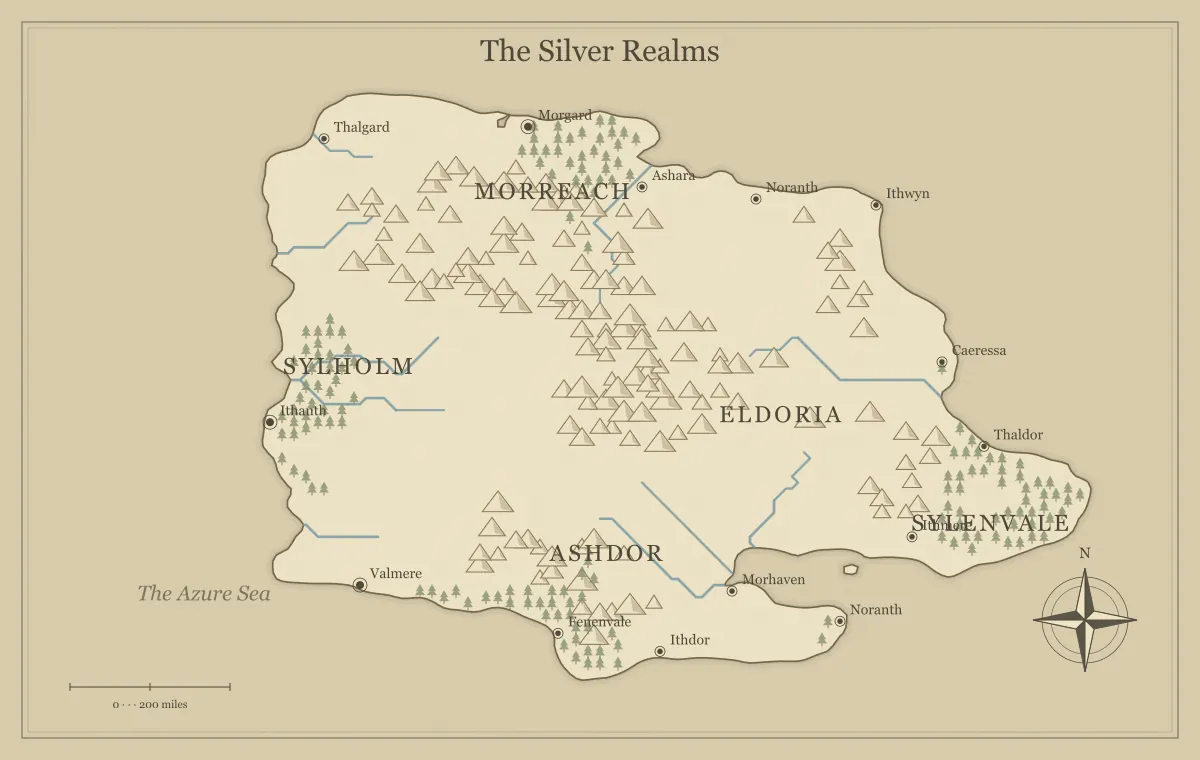
A campaign world becomes useful when players can make choices inside it. A map full of names and mountain symbols is not yet an adventure, but it can become the framework for one. The most productive starting point is a small set of places with clear relationships: somewhere the party can begin, somewhere nearby that creates a problem, and somewhere farther away that gives the campaign room to grow.
This guide uses a DND world map maker with no login as a preparation aid. You can generate a continent, rename locations, add a landmark, and download a player reference without first building an account or a complete setting encyclopedia. The examples describe a fictional coastal region called the Lantern Coast. They focus on campaign structure and information design rather than the rules of a particular game edition.
Define the campaign’s promise before its history
Write a short promise describing the kind of adventure the world will support. “Explorers uncover the history of a coast whose old signal towers have gone dark” tells you more about useful map locations than a list of royal dynasties. It suggests ports, towers, interrupted routes, and communities affected by the problem. Those are things the party can encounter and influence.
Keep the promise broad enough for player choices. The signal towers may connect to an old disaster, a present conflict, or a misunderstood natural change. You do not need to decide the entire explanation before the first session. The map should make the promise visible through places that invite questions. If every marked location is unrelated to the campaign’s central interests, preparation can become a collection of disconnected ideas rather than a setting the group can understand.
Choose a starting region that the party can grasp
A continent is often a good working canvas for a campaign because it offers several directions without requiring a complete world overview. An island can work better for a limited campaign or a clear initial boundary. Choose the type that helps the group understand the places they might reach in the next few sessions. The map can contain more territory than you immediately explain.
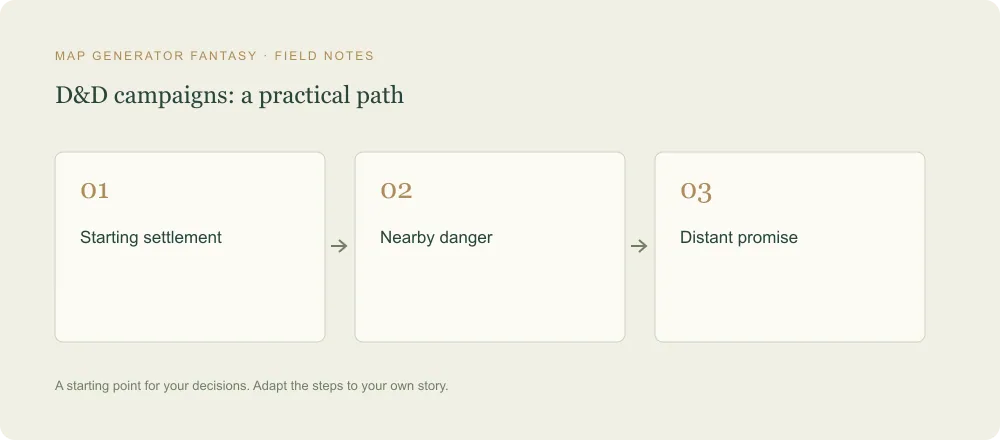
For the Lantern Coast, find a sheltered port, an inland ridge, and a stretch of remote shoreline. Those features support the initial promise without requiring a dozen kingdoms. If you are deciding between a world and a smaller map, use the guide to map types and story scope. Start with the area you can give meaningful attention rather than assuming that campaign depth depends on the number of continents.
Give the starting settlement a practical role
The starting town needs to do more than provide a name on the map. Decide why people live there, how travelers arrive, and what the party can learn there. Lantern Harbor might have a river landing, fishing boats, a market, and an official who worries about ships missing the entrance after sunset. These details connect the town’s daily life to the wider campaign problem.
Choose one person who can explain the immediate situation, one place where the party can hear conflicting accounts, and one reason to return after an expedition. Keep those notes outside the map rather than placing every business on the geographic overview. The town marker is an anchor for information, not a substitute for it. A simple settlement can feel alive when its needs and routes are understandable.
Place a nearby danger with a visible consequence
The first danger should affect something the party can recognize. A ruined signal tower beyond Ash Pass might be the destination of a missing repair crew. A damaged bridge could interrupt trade between the port and nearby farms. A coastal cave might be connected to lights seen offshore. The geography gives the problem a location; the consequence gives people a reason to care.
Avoid making the first site a destination with only one possible interpretation. The tower may be dangerous, but the party can investigate, seek local help, or find another route. Decide what remains observable before they arrive: a road that is suddenly quiet, a delayed shipment, or an anxious family waiting for news. Those clues connect the town, the map, and the adventure without requiring a long exposition speech.
Add a distant promise that can wait
A distant location gives the campaign a horizon. It might be a northern observatory, an island visible in old charts, or a capital that refuses to explain why the towers were abandoned. Mark the place, give it one memorable fact, and leave room for the campaign to change its significance. The party does not need a complete adventure there immediately.
For the Lantern Coast, the Northern Watch could appear in several rumors. One person believes it still keeps records of the signal network. Another thinks it was destroyed decades ago. A sailor claims to have seen a light near its shore. Contradictory information makes the distant location interesting while preserving uncertainty. The map shows where the question points; play can determine when the group decides to follow it.
Connect locations with choices instead of a single itinerary
Look at the terrain between your three main places. Can the party cross the ridge, travel along the coast, or arrange passage by boat? Give the routes different practical consequences. The pass may be faster but uncertain after a storm. The coast may be safer but expose the group to a local authority. A boat may avoid the ridge while depending on a captain’s schedule.
Present enough information for the choices to mean something. A route that is secretly worse in every way is not an interesting decision unless the uncertainty is part of the story and can be investigated. Record the obvious advantages, known risks, and unknown factors for each route. The guide to campaign travel routes develops this approach without turning every journey into an identical encounter sequence.
Introduce factions through the places they affect
A faction is easier to understand when players can see what it wants and where it acts. The harbor council may control the main landing. A group of tower keepers may maintain one inland site. A shipping company may want a new route that bypasses the old network. Their relationships can appear through requests, access to routes, and changes in the places the group already knows.
Do not cover the map with faction labels before the party has met them. Begin with a few notes attached to relevant locations. Distinguish control from influence: a group that owns a warehouse does not necessarily govern the whole town. Mark contested or uncertain relationships in your preparation rather than drawing a false impression of fixed territory. The field note on faction information on campaign maps explains how to avoid crowding the illustration.
Prepare player information separately from private notes
The players’ map should reflect what their characters can reasonably know. A harbor, a familiar road, and a distant named headland might be common knowledge. The entrance to a hidden ruin or the identity of a secret faction may belong only in your preparation. Decide what the handout communicates before exporting it.
The generator can hide place names for an unlabelled version, while the editable working file retains your changes. For more selective information, keep separate versions with clear file names or use a companion document for private notes. Do not rely on remembering which image contains a spoiler. A player copy and a DM copy should be distinguishable even when opened months later. The guide to player and DM map versions provides a useful method.
Make rumors actionable and attach them to locations
A rumor should help the group consider a next step. “The north is strange” is atmosphere. “A ferryman saw a working signal at the abandoned Northern Watch three nights ago” points toward a person, a place, and a question. Write a few rumors that connect the starting town to nearby and distant locations without all implying the same route.
Mix certainty carefully. Some rumors can be reliable observations with uncertain explanations. Others can reveal a speaker’s interest rather than objective truth. Give the party a way to learn which details matter. If every rumor is deliberately misleading, the map stops being a useful planning tool. The audience should be able to build an increasingly informed understanding of the region through exploration.
Leave useful empty space instead of unfinished obligations
You do not need a full description for every generated town. A name can remain a prompt until play approaches it. Empty regions can represent places outside the current campaign’s focus, not failures of preparation. Keep a short list of possibilities for those spaces, but avoid turning every possibility into a commitment that must be maintained.
When a player creates a hometown or asks about an unexpected route, use that interest to develop the relevant area. A map with room to grow can respond to the group without contradicting pages of unused lore. Record the new fact clearly and update the working copy. Collaboration works best when the group can see how its choices and ideas become part of the setting, rather than discovering that every detail was fixed before the first session.
Keep the working file and session updates together
Save an editable JSON map file after the initial preparation. Keep it beside a short campaign note containing the current date in the fiction, the locations the party has visited, and the unresolved questions that now matter. An exported image is useful for play, but it is not the same as the editable source used by this generator.
After a session, add only the map changes that became real in play: a renamed settlement, a new stronghold, a discovered landmark, or a revised public label. Do not rewrite the entire setting in response to one improvised line. Save a dated version and export the next player copy when needed. The guide to maintaining a map between sessions helps keep that routine short enough to continue.
Review the map against the first session’s needs
Before play, ask whether the group can identify the starting town, understand at least one immediate problem, and choose a direction without receiving a lecture. Check that the place names are readable at the size of the handout. Prepare a short description of the most likely arrival at the nearby danger, but leave alternatives open.
The campaign world is ready to begin when it supports those decisions. It does not need a finished history of every coast. Let the first sessions reveal which parts of the landscape deserve more attention. A map becomes a campaign world through the group’s repeated contact with its places, the consequences of its choices, and the questions that make the players want to see what lies beyond the next visible landmark.
Give the idea a world of its own.
Try the technique in the generator, then save an editable copy so you can return to your work.
Open the map maker ↗