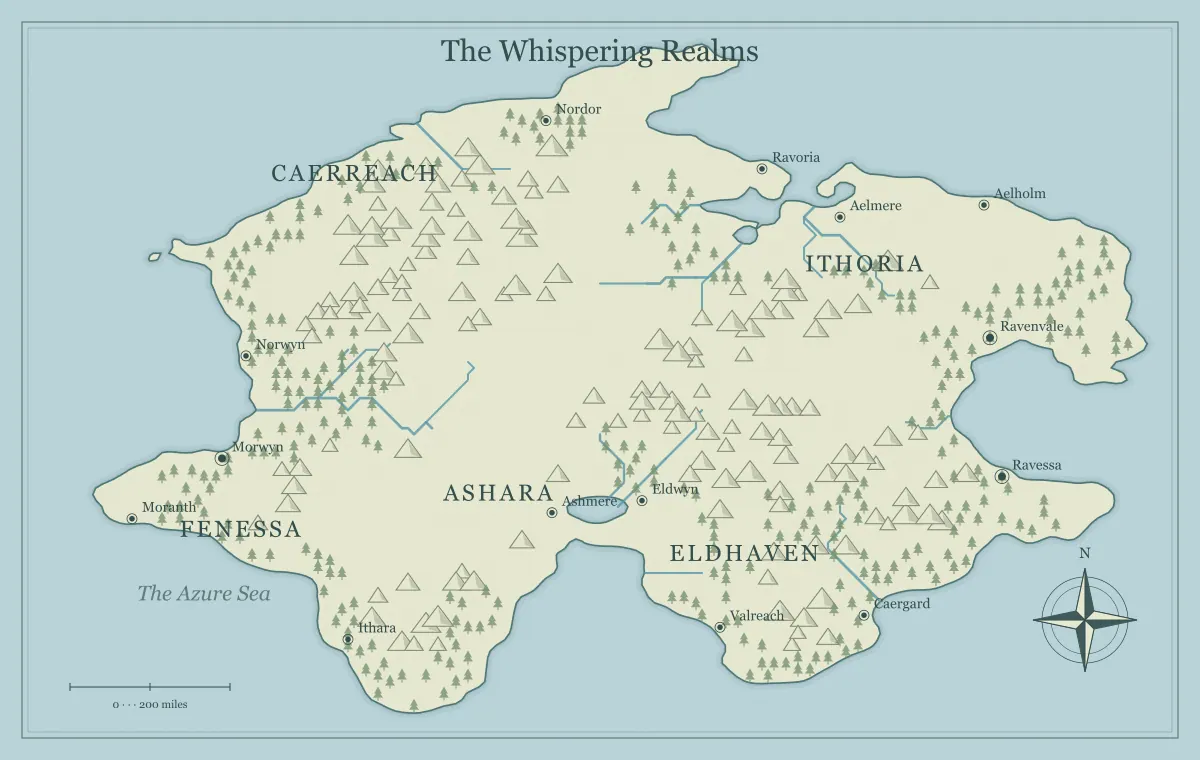
A campaign map becomes more valuable when it remembers what happened during play. A repaired ferry, a newly discovered ruin, or a change in who controls a pass can alter the group's next decision. Updating those facts helps the setting feel responsive. The difficulty is keeping the map coherent without turning every session into a complete redraw. A short maintenance routine can preserve geography, distinguish knowledge from world changes, and produce a clear handout when one is actually needed.
This guide follows an original region called the Oakwater March through several sessions. Use the DND world map maker for the geographic overview, then keep editable files and a compact session record. The tool is independent of tabletop publishers and does not automatically synchronize a campaign history. Your notes and saved versions provide that continuity. The aim is a useful current map with a recoverable record of important earlier states.
Capture changes while they are still clear
After a session, write a short list of things that changed. In Oakwater, the group repaired a ferry landing, learned the location of an old watch post, and negotiated temporary access through the pass checkpoint. Those are three different changes. Record them before details become mixed with plans for the next adventure. You do not need to transcribe every conversation to maintain the map.
For each item, include the place, the change, and the audience that knows it. The landing is physically repaired. The watch post was already there but is newly known. The checkpoint agreement applies to this group and may be temporary. These distinctions determine whether the map, player notes, private index, or all three should change. A concise record is more useful than a broad statement that the party improved the region.
Separate world changes from knowledge changes
A world change alters the setting: a bridge is rebuilt, a port closes, or a faction occupies a station. A knowledge change alters the characters' understanding: they discover a path, correct a rumor, or learn an alias. If you treat both as newly created geography, the setting can become inconsistent. Record the difference explicitly so an earlier map remains understandable as a snapshot of either the world or a viewpoint.
The Oakwater watch post is a knowledge change. It should appear on the player map after discovery without implying that it was built between sessions. The repaired landing is a world change and can alter route notes. The player and DM map guide provides a knowledge inventory, while travel routes explains how physical changes affect movement and choices.
Keep the main geography stable unless the story changes it
The coastline, major river, and mountain ridge should remain consistent across ordinary updates. Regenerating terrain after each session can move landmarks that players already use for orientation. Save the chosen working state and edit the information that actually changed. If a magical event reshapes the land, treat that as a major setting change with an explanation and a separate approved version.
A seed helps identify a starting point, but the saved editable file preserves supported settings and manual edits more directly. Keep a reference image too when the exact approved appearance matters. The seed guide explains version-dependent reproducibility, and editable saving provides a recovery routine. Stable geography lets the group's accumulated knowledge remain useful rather than forcing everyone to relearn the map.
Update only what affects a useful decision
Not every event belongs on the regional image. A new contact at the inn may matter in the location notes but not alter the overview. A reopened ferry matters because it changes routes. A discovered major ruin can deserve a marker because it becomes a destination. Ask what the update helps someone do before adding another label. This keeps the map from becoming a crowded diary of every session.
Prioritize changes likely to affect the next few decisions. You can retain smaller details in the notebook and add them to a local view if needed. The notebook guide explains how an image and notes can share the work. The quality checklist helps determine whether new information improves the map's purpose or merely adds visual weight.
Use filenames that describe audience and state
Name working files consistently, such as oakwater-player-v3 and oakwater-dm-v3. Include a date when it helps distinguish session updates. Avoid relying on final, final-new, and final-fixed as the whole naming system. Those names stop being useful as soon as another revision occurs. A clear audience label also reduces the risk of distributing a private preparation map by mistake.
Keep one current approved player export in the sharing folder and earlier versions in an archive. The working files can live with the session notes. This is a simple file-management habit rather than a requirement for special software. When someone asks which map is current, the answer should be obvious from the folder and version note. The export guide explains why an editable file and an approved picture should be preserved separately.
Review public and private information independently
The players may know the landing is repaired and the watch post exists, while your private notes contain a faction's planned response. Update the player version with discoveries they can use, then update the private index with intentions and hidden consequences. Do not copy every private change into the public map simply because you are making a new version.
Inspect symbols, titles, captions, and filenames as well as labels. A concealed location can leak through an unnamed marker or a revealing image name. The audience version guide provides a release audit. Information should become public through play or an established source, not through an accidental export of your preparation layer.
Keep route conditions close to the places they affect
The repaired Oakwater landing changes the river route. Record the effect in the route note: unloading is reliable again, and the ferry association can operate its normal schedule under the campaign's ordinary conditions. Do not automatically conclude that every journey is now safe or that weather no longer matters. Update the specific constraint that the group resolved.
Likewise, the checkpoint agreement may apply only to the characters or expire after a particular event. Keep that qualification in the notes rather than presenting the whole pass as permanently open to everyone. The travel guide separates distance, effort, and uncertainty. That distinction helps you revise routes coherently while preserving the consequences players earned.
Update faction goals through established interests
After the landing repair, the river association may support the group, the council may expect grain deliveries, and the pass wardens may request similar help. Record those reactions according to each faction's assets and needs. A generic approval score can be useful in some campaigns, but it should not replace the explanation of what changed in the relationship.
If control of a service changes, update the faction index and any public label that needs it. A private intention to seize the service should remain private until discovered or enacted. The faction mapping guide distinguishes control, ownership, and influence. Keeping those categories separate prevents one negotiated favor from accidentally becoming a claim that the group now governs the entire region.
Keep unresolved information visibly unresolved
A rumor can become more credible without becoming confirmed. If the group hears a second report of a hidden valley, record the new source and leave the exact location uncertain until the fiction establishes it. The player map may gain a broad lead or a note rather than a precise marker. This preserves the distinction between what is possible and what the characters can confidently act on.
When a rumor is disproved, explain the correction through the campaign record. An earlier chart can remain an old viewpoint rather than an inexplicable error. The hidden world guide explores concealed, inaccessible, and unknown places. A maintainable map does not need perfect information; it needs a coherent account of why information appears, changes, or remains incomplete.
Give players a concise change note
When you distribute a new map, include a short description of the important differences. “The ferry landing is repaired; the watch post is now marked; the pass agreement applies to your party” tells players what to look for. They should not have to compare two large images pixel by pixel to discover why the new version matters. Keep the note tied to their knowledge.
If the visible image did not change, a revised route note may be enough. Do not publish another picture simply to show that you did maintenance. The purpose is useful shared information. For online groups, retain a clear current version where everyone can find it. For printed play, tell the group whether the old handout remains accurate or which small annotation would update it.
Verify the saved and exported versions
Download the edited JSON and open the actual picture export. Check the changed labels, markers, and frame. If the map will be printed, inspect the new text at its intended size. A small added label can collide with terrain even when the previous version was readable. Repeat the checks affected by the revision rather than assuming a previously approved image makes every future edit correct.
Keep a baseline before major changes and avoid overwriting the only recoverable version while testing. The controlled iteration guide explains focused revision, and final review adds delivery checks. Browser storage is convenient, but the campaign archive should remain usable if you change devices or clear local data.
Use a short Oakwater maintenance routine
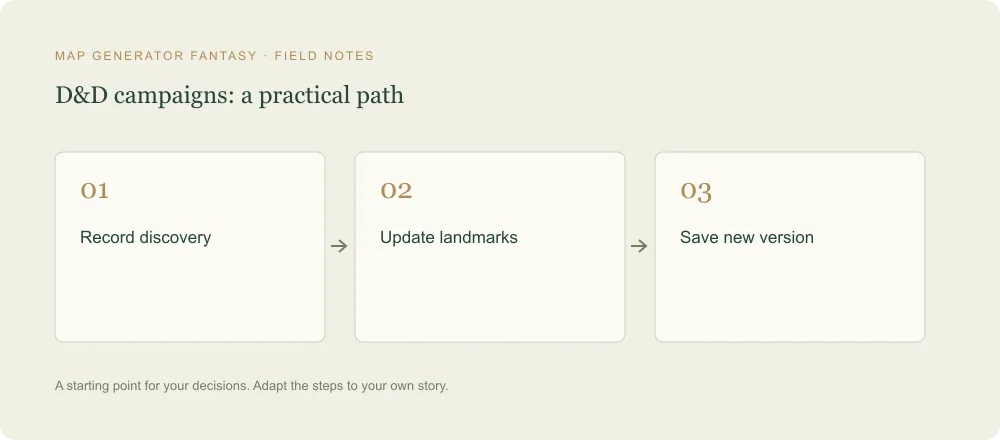
A practical routine has four actions: capture changes, classify them, revise the relevant files, and verify the current handout. For Oakwater, that means noting the repaired landing, adding the discovered watch post to player knowledge, qualifying the checkpoint agreement, and saving version three. The process can stay small because it follows actual events rather than trying to develop every unexplored part of the map between sessions.
Over time, the map becomes a record of the group's influence. Routes open, relationships change, and formerly uncertain places become known. Stable geography and clear versions let those developments accumulate coherently. A campaign map is most useful between sessions when it preserves what the players learned and changed, while keeping your preparation flexible enough to respond to what they choose next.
Give the idea a world of its own.
Try the technique in the generator, then save an editable copy so you can return to your work.
Open the map maker ↗