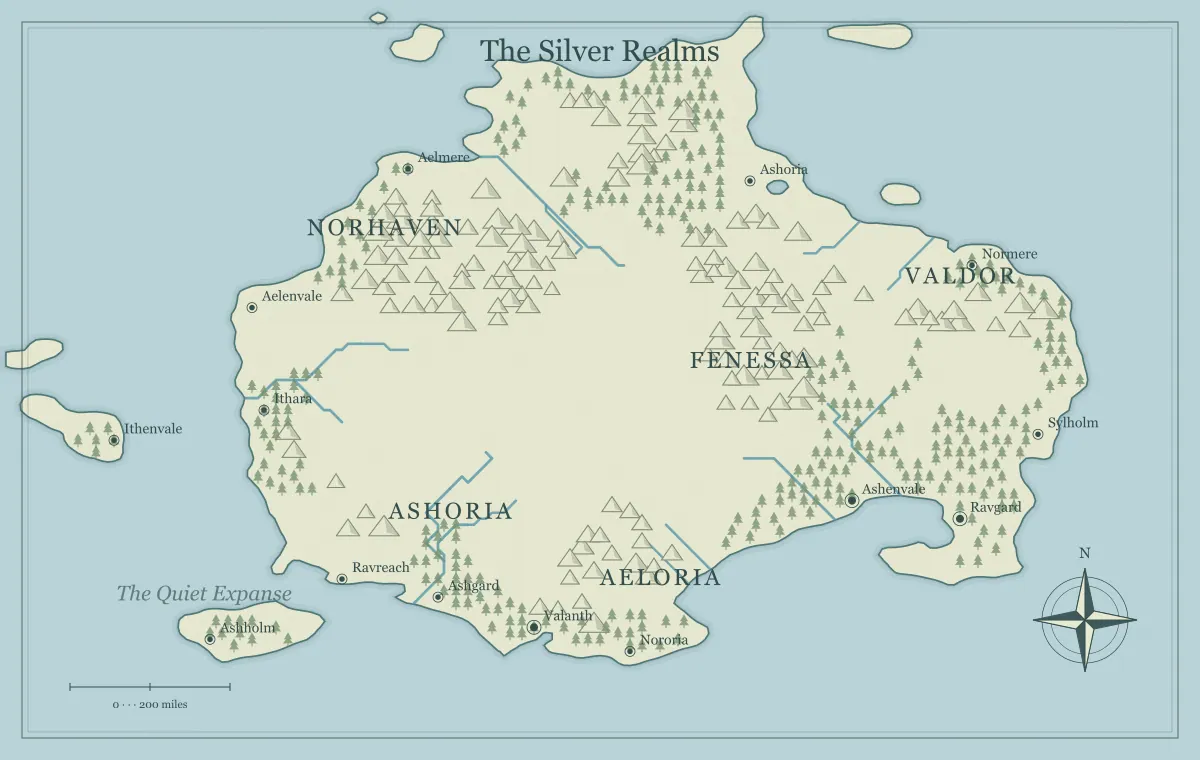
A fantasy map can show where a place is without preserving why you put it there. Months after drawing a frontier, you may remember its name but forget whether it marks a political dispute, a dangerous forest, or a convenient limit for the first adventure. A worldbuilding notebook keeps that reasoning beside the image. It need not become an encyclopedia. Its job is to preserve decisions that affect the story, record useful uncertainties, and help you return to the project without rebuilding your own intentions from memory.
This guide develops a notebook for a fictional region called the Amberfen Reach. A writer uses a fantasy map generator to establish a river valley, neighboring hills, and a coastal outlet. The notebook holds information the geographic illustration cannot carry clearly: travel assumptions, seasonal changes, relationships between settlements, and unresolved questions. The same method works for a tabletop campaign or a shared setting, provided you separate what the audience knows from information intended only for the creator.
Start with one page that identifies the project
The first page should identify the project, its purpose, its current map edition, and the intended audience. Amberfen's purpose is to support a story about a messenger traveling between a market town and an isolated monastery. The current edition is Amberfen planning map 02. The audience is the writer and an early reader. That short record prevents a later export from being mistaken for a finished reader map or a different region with a similar title.
Include the filenames of the editable map and its approved image export. Record the seed and broad settings as useful context, while recognizing that they do not replace an editable file containing manual changes. If you keep notes in a separate application, write enough information to find the files again. A note saying “the latest map” becomes ambiguous as soon as another map exists.
Use the editable saving guide to distinguish working data from a picture. A notebook links these artifacts together. It does not need to contain an embedded copy of every file, but it should tell the next person opening the project which files belong to the same release.
Build a small place index
Create an index of places that matter to the current project. Give each one a stable written name, a short identifier if useful, an approximate location, and a one sentence role. Amberfen's entries begin with AM01 Reedmarket, a river trading town; AM02 Lantern Ford, the crossing on the northern route; and AM03 the Ash Monastery, a destination in the hills. Stable identifiers help track a place if its public name changes during revision.
Do not begin by cataloguing every generated symbol. A map can contain settlements that remain background until the story needs them. Listing hundreds of places creates maintenance work before their purpose is clear. Start with the locations that appear in scenes, affect travel choices, or explain an important relationship. Add another entry when it becomes useful rather than treating every visible dot as an obligation.
Approximate locations should be understandable without pixel coordinates. “Above the eastern river bend, before the hill road divides” remains useful when the image is resized. If you later need exact coordinates in another application, record them with their reference system. A coordinate is meaningful only when someone knows which edition, scale, and tool it refers to.
Give important places compact location cards
Each location card can answer five questions: what is here, who uses it, what can happen here, what limits access, and what remains undecided? Reedmarket contains a ferry, warehouses, and a weekly grain market. Traders and nearby farmers use it. The messenger can exchange news there. Flooding sometimes interrupts the approach road. The writer has not decided who operates the ferry after sunset. These notes immediately support scenes without requiring a full civic history.
Separate visible description from background explanation. A visitor may see ropes, loading platforms, and muddy carts without knowing the ferry operator's arrangement with the monastery. That difference helps you write what a viewpoint character can actually observe. It also helps a game master prepare player information without copying secret notes into a public handout.
Keep the card proportionate to the place's role. A recurring settlement deserves more detail than a crossroads mentioned once. If a card becomes long, put the most useful summary first and move optional history below it. The settlement placement guide can help connect a town's purpose to geography, while the notebook preserves the specific explanation chosen for your world.
Record connections as their own entries
A map shows two locations near each other, but proximity does not explain their relationship. Keep entries for important connections: the road between Reedmarket and Lantern Ford, the ferry crossing, and the hill path to the monastery. Each entry should identify its endpoints, usual users, travel conditions, and the reason it matters. A journey often depends more on these connections than on either destination alone.
For Amberfen, the road north is broad enough for carts during ordinary weather but crosses low ground that becomes difficult after prolonged rain. The hill path is shorter in distance and harder to travel with heavy cargo. These are fictional setting assumptions, not calculations produced by the map engine. Writing them down keeps later scenes consistent when a character chooses between speed, comfort, and carrying capacity.
Link connection entries to the relevant place cards. A change to Lantern Ford should prompt a review of the northern road, rather than leaving a route note that assumes a functioning crossing after the crossing has been destroyed. The scale and distance guide explains how to establish a chosen distance convention. Record that convention once and refer to it instead of inventing incompatible travel estimates in separate chapters.
Distinguish facts from proposals and rumors
Use explicit statuses for notes: approved, possible, rumor, and retired. An approved fact is part of the current setting. A possible idea is under consideration. A rumor is something a character or community believes, whether or not it is true. A retired note explains an earlier version that no longer applies. These statuses prevent imaginative brainstorming from becoming accidental canon.
The Amberfen notebook marks “the monastery has no western entrance” as approved. “A buried stair might reach an old chapel” is possible. “Pilgrims hear bells underground” is a rumor. These ideas can coexist because they serve different roles. If the writer approves the buried stair later, the monastery card and relevant scene notes need an update. The rumor might remain uncertain to the characters even after the writer knows its explanation.
A notebook can hold contradictions temporarily if their status is clear. It should not present incompatible statements as equally established facts. When a contradiction affects the current story, resolve it or identify the question that remains open. A deliberate mystery gives the creator control over what is unknown; an unnoticed contradiction merely shifts the problem to the reader.
Track time without building an unnecessary calendar
Record changes that affect the map's use. A bridge closes, a fair attracts travelers, a settlement changes allegiance, or winter makes a pass difficult. You may only need a sequence of events rather than a fully named calendar. Amberfen begins with three relative markers: before the messenger leaves, during the journey, and after the monastery meeting. That sequence is enough to check whether news could have reached a town before the messenger arrives.
Seasonal notes should connect to consequences. “Wet season” is less useful than “the low road is unreliable, so grain carts queue at the higher crossing.” The latter affects travel, trade, and potential encounters. Make those consequences easy to find on the relevant route and place cards. A general climate note can remain in a separate section, but users should not need to reread every worldbuilding paragraph to understand a practical journey restriction.
The map image may represent one period while the story spans several. Identify the period in the notebook and, if relevant, in the published caption. A ruined bridge on a later map does not mean it was ruined in an earlier scene. Maintaining that distinction lets geography change through the story without making earlier editions appear erroneous.
Link notes to scenes and decisions
Each major location can include references to the scenes, sessions, or chapters that use it. Keep these references brief and stable enough to find. Reedmarket appears in the departure scene and the final return. Lantern Ford appears in the first route decision. The monastery appears in the meeting that changes the messenger's mission. These references show which manuscript sections need review when a geographic assumption changes.
Also record the decisions a place supports. Lantern Ford matters because crossing there adds delay but provides reliable information. If a revision makes the ford easy, empty, and instantaneous, the route decision loses its purpose. The notebook should preserve that narrative relationship rather than only the physical description. A place name can remain unchanged while its story function changes substantially.
The journey and story structure guide develops this connection between movement and choices. Use the notebook to keep track of your own decisions after applying that reasoning. A guide suggests questions; the project notes preserve the answers that are specific to your story.
Give open questions a review path
An open question needs enough context to be revisited. “Who owns the ferry?” is useful when connected to Reedmarket and the scenes it affects. Add a reason the answer matters and a point by which it must be decided. If ownership has no effect on the present story, leave it open without treating it as overdue work. Not every uncertainty deserves immediate resolution.
Amberfen's writer postpones the ferry operator's family history but decides its operating hours before revising the departure scene. The first question adds depth; the second determines whether the messenger can leave after dark. This distinction keeps notebook work from becoming a substitute for writing. A question should be answered when the project needs its consequence, not merely because the blank space feels uncomfortable.
During a review, move answered questions into the relevant cards and record the decision briefly. Do not leave the same question unresolved in one list and settled elsewhere. If an idea is discarded, mark it retired rather than deleting all evidence when its earlier version may still explain old files or draft scenes.
Maintain a short edition log
An edition log records what changed between map releases. Three clear lines can be enough: renamed the ford; removed an unused landmark; increased the monastery label size. Include the date, edition name, and filenames. Describe meaningful changes rather than every click. The log helps you understand whether a saved image and a notebook reflect the same state.
Distinguish a presentation revision from a setting revision. Increasing a label size improves appearance without changing the fictional world. Moving the monastery in a later external editor may change travel and scene assumptions. Both deserve a record, but only the second necessarily requires checking route cards and the manuscript. That distinction prevents either excessive review or an overlooked structural consequence.
When several people contribute, the collaborative worldbuilding workflow provides a simple proposal and approval process. The notebook becomes the decision record behind that process. One agreed current edition is easier to maintain than several competing files whose status is known only to the person who saved them.
Prepare a separate reader edition
A planning notebook can contain spoilers, abandoned plot ideas, unpublished text, and private comments. Do not assume it is suitable to distribute simply because the map is ready. Prepare a reader summary that includes only the information the audience needs. For a campaign, this may be a place list, route descriptions, and common knowledge. For a novel, it may be a short gazetteer or a caption that explains the map's scope.
Review shared links and files as well as visible labels. A share link can carry supported settings and edits in its fragment; it does not provide access control or selective disclosure. The editable file may contain names that are absent from a simplified image. If secrecy matters, distribute the intended picture or a carefully reviewed separate edition rather than the creator's complete working material.
The player and game master edition guide and hidden worlds guide describe audience planning. Their central lesson applies to notebooks too: decide what the recipient should know, then inspect the actual artifact being sent.
An Amberfen maintenance example
After a draft chapter, the writer decides that the messenger should miss the ferry and take the northern road. The notebook update begins with the route decision, not a new continent. Reedmarket's card gains the ferry's closing time. The northern road entry gains an evening travel note. Lantern Ford's card gains the person who can provide information there. The departure scene reference points to the revised chapter. The map only needs a clearer ford label.
The writer saves Amberfen planning map 03, exports its image, and logs the label change. The setting notes explain why the road now matters more. The earlier file remains in an archive folder because a collaborator may still be commenting on it. When those comments arrive, the edition name identifies which version they concern. A small amount of structure saves the writer from guessing whether the feedback describes a current issue or an earlier arrangement.
The monastery's possible buried stair remains undecided. Nothing in the route revision requires that answer. Leaving it open preserves a useful possibility without distracting from the completed travel sequence. A notebook succeeds when it supports the next real task, not when every imagined place has a complete history.
Return to the map with a specific task
Before each editing session, read the purpose page, check the current edition, and choose the decisions that need a visual change. Keep the rest in prose. Save the editable file and image when the batch is reviewed, then update the log. This cycle makes a fantasy map maker part of a durable creative process rather than a collection of unrelated exports.
Open the fantasy map maker when you have a concrete change to apply. Use the final review checklist before distributing a finished edition. Your notebook can remain informal, but its essential links between places, decisions, scenes, and files should be clear enough that returning to the world feels like continuing a project rather than starting it again.
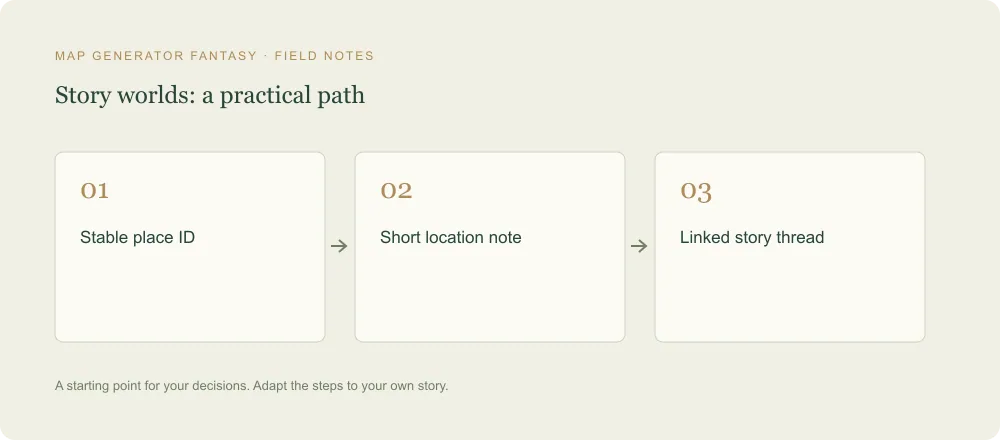
Give the idea a world of its own.
Try the technique in the generator, then save an editable copy so you can return to your work.
Open the map maker ↗