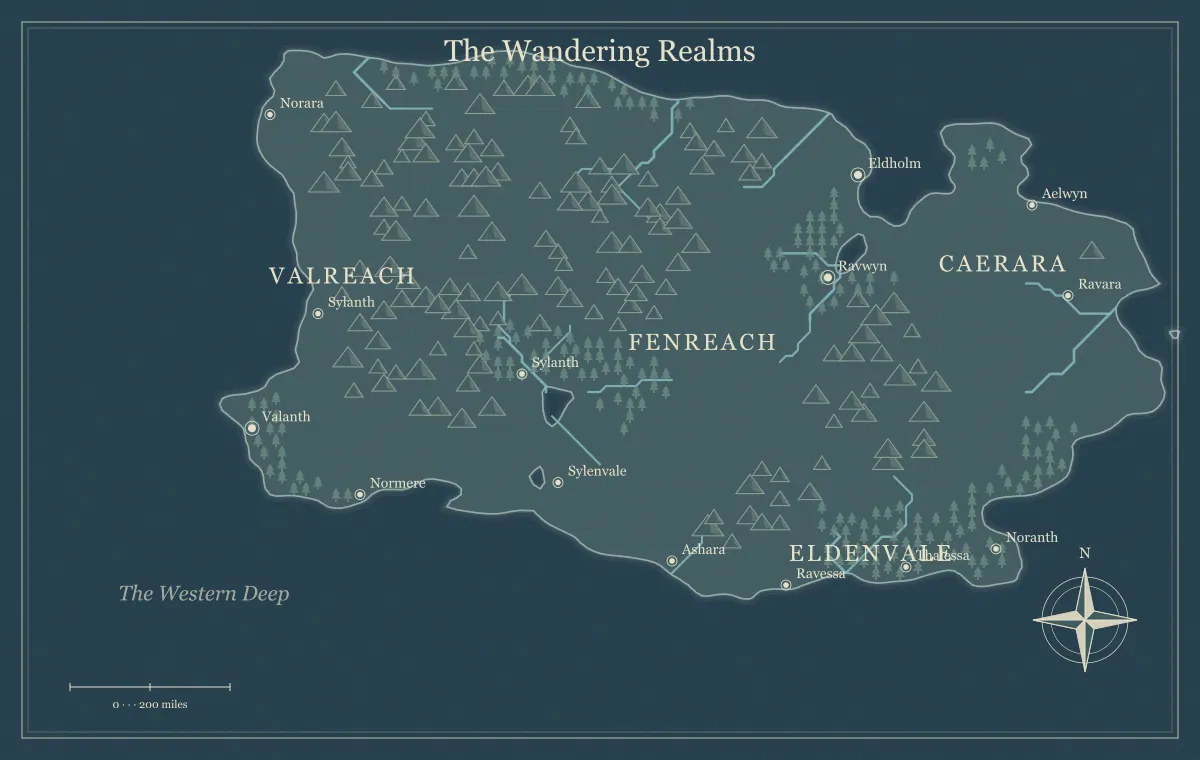
A fantasy name generator is useful when you have a character, settlement, or kingdom in mind but cannot find the right words for it. The first result rarely needs to become the final name. Think of generated names as ingredients: sounds to test, combinations to reshape, and prompts that help you notice the identity of a place. A memorable name should work in the mouth of a reader, at a busy game table, and on the map where it will appear.
This guide connects naming with worldbuilding rather than treating the task as a lottery. You will choose a sound pattern, generate a small set of options, attach a reason to the name, and check whether someone else can distinguish it from neighboring names. The examples are invented for this article. They are starting points, not claims about the meaning of words in a real language or guarantees that a name has never appeared elsewhere.
Try a small fantasy name generator
The naming aid below runs on your device. Choose whether you need a character, a town, or a realm, then choose a broad sound family. It combines invented beginnings and endings to produce eight suggestions. The sound-family labels describe the feel of these particular combinations; they do not assign a universal character to a language or a culture. Generate a shortlist, read it aloud, and keep only the options that serve your world.
A generated character name can become a surname, an old family name, or the starting syllable of a place. A generated town name may need shortening before it fits on a map. Keep a separate note for rejected options that contain a useful sound. You can return to those fragments later instead of generating hundreds of nearly interchangeable results.
Name the role before you name the person or place
Begin with a sentence explaining what the name needs to accomplish. A harbor town may need to sound welcoming because it is the party’s first safe destination. A ruined fortress might need a name that people can remember after hearing one rumor. A diplomat’s name should be easy to say during dialogue, while a legendary monarch can support a longer ceremonial title. These are different jobs, so they deserve different shortlists.
Imagine a town where a river meets the sea. Your brief could be: “A working port whose name suggests shelter, without sounding luxurious.” That gives you a filter for results. Saelhaven fits that brief more naturally than a four-word imperial title. Now imagine an isolated hill settlement known for an abandoned watchtower. A shorter name such as Torven may leave more room for a local nickname. The role gives you a reason to accept or reject a suggestion.
Choose a sound family for related names
A sound family is a small set of choices you reuse within a region: a few beginnings, endings, consonant combinations, or syllable lengths. It is a design aid, not a complete constructed language. If coastal settlements often use an “ae” sound and inland places often end in “ford” or “vale,” readers can begin to recognize a pattern. You do not need to apply that pattern to every name.
Write down three examples that feel related without sounding identical. Saelara, Vaelith, and Neraen share some texture, but each has a different outline. Then test an exception. A port called Old Bridge may be named by travelers instead of local inhabitants. The exception suggests history rather than failure. The companion guide to memorable fantasy place names explains how to connect these patterns to a map full of towns and regions.
Keep character names distinct in conversation
Characters need to survive spoken conversation. Put a candidate inside ordinary sentences: “Ask Aelwen about the ferry,” “Torven has the key,” and “Miraessa refused the bargain.” Read those lines at your usual speaking pace. If you stumble twice, shorten the name or change the combination that catches your tongue. Difficulty is not the same thing as depth, and an elaborate spelling does not automatically make a person feel ancient.
Next, compare the important names in the same scene. Aelwen and Aelwyn may look different in notes but become confusing when spoken quickly. Give recurring characters different opening sounds where possible. You can keep similar family names if the relationship matters, but make first names easy to distinguish. For a tabletop campaign, introduce a long name alongside a stable nickname rather than forcing the group to invent a different abbreviation every session.
Give place names a reason to exist
A place name can refer to a crossing, a local resource, a founder, a landmark, or a memory. Choose one reason for the name you keep. “Ashford” suggests a crossing associated with ash trees. “The Lantern Reach” might describe a stretch of coast marked by signal lights. “Caeressa” can be an inherited local name whose meaning is no longer obvious to outsiders. You decide which explanation belongs to your fictional world.
Try a two-line location note: the formal name on the first line, the everyday explanation on the second. You might write, “Saelhaven: named for the sheltered mouth of the river; sailors usually call it The Haven.” This small amount of context is enough to make the name useful. You can add deeper history later if the place becomes important. The map remains readable while your notebook carries the explanation.
Use realm names and titles with restraint
Kingdoms and realms often need two forms: a compact map label and a longer title used in formal writing. “The Valorian Marches” may become “VALORIA” on the map. A ruler could use a ceremonial title that is longer still. Separating these forms avoids making every region label a paragraph. Decide which form the audience actually needs at the moment they encounter it.
Do not make every realm a kingdom if the political distinctions matter. A coastal league, a border march, and a collection of independent islands can have different naming habits. These distinctions should come from the setting you are building, rather than a generator’s random choice of suffix. If you are developing political relationships as well as names, connect the shortlist with the guide to fantasy kingdoms and geographic conflict.
Test the name where readers will see it
A name that looks elegant in a notebook may crowd a small coastline. Put the candidate on the map before deciding it is finished. Check its length, the available empty space, and the marks around it. A town beside a river may need its label moved slightly inland. A long island name can sit in open water if it remains clear which landmass it identifies. Avoid shrinking one name until it disappears just to preserve the first spelling you generated.
In the map maker, click a place label to edit its text. You can also change the size, font, or color and drag the label into a better position. A separate guide to fantasy map label typography covers hierarchy and placement. Names should support the drawing rather than fight for the same small patch of space. Test the exported image too, because that is the version readers may actually receive.
Use nicknames to reveal different perspectives
Different people can name the same place differently. Traders might call a dangerous channel “The Toll” because passage is expensive. Local inhabitants may use an older name. Officials may insist on a newly declared title that no one else adopts. You do not need all three forms printed together on the map. Choose the form appropriate to the map’s fictional author and keep the alternatives in your notes.
This can create a useful mystery. A letter names “Neressa,” while the modern map shows “Lantern Harbor.” The party must discover that both refer to the same location. Use such puzzles sparingly and give the audience a fair clue. If every place has several unexplained aliases, naming becomes a barrier to understanding. One carefully placed alternate name can carry more story value than a page full of obscure substitutions.
Be thoughtful about real-world inspiration
You can learn from the way real place names refer to terrain, occupation, or history without presenting invented combinations as authentic words. If you borrow directly from a living language, verify the meaning and context with reliable language resources rather than assuming a generator knows them. Do not describe an invented name as a faithful translation unless you have checked that claim. The naming aid here makes no such claims.
For public projects, check important names in the places where you plan to use them. A web search, a search of your own manuscript, and a review of existing characters can reveal obvious collisions or unintended associations. This is a practical editorial check, not a guarantee of legal clearance. When a borrowed cultural reference is central to the project, deeper research or feedback from knowledgeable readers is more useful than producing another random shortlist.
Keep a short naming register
A naming register is a simple list of decisions you have already made. Record the accepted spelling, pronunciation note if needed, place or character role, and any nickname. Add the sound family or regional pattern beside it. The point is to stop the same name drifting between drafts. A character should not become “Vaelith” in one chapter and “Vaelithh” in the next because an earlier suggestion was copied by accident.
For a shared campaign or writing project, designate which version of the register is current. A table with one row per important name is often enough. Keep rejected names in a separate area so they do not look like active locations. If you are mapping the setting alongside the register, use a saved editable map file as the visual baseline. The guide to saving and versioning a fantasy map provides a practical routine.
Work through one complete naming session
Suppose you are preparing a small coastal campaign. You need a starting port, a nearby island, and a local guide. Begin with the shared sound family, then generate a shortlist for each role. Keep Saelhaven for the port because it reads as a sheltered settlement. Keep Neraen for the island because its compact shape fits the available map space. Choose Miraessa for the guide, then test whether the group can distinguish it from the island name in spoken conversation.
Add reasons: Saelhaven grew around a safe river mouth; Neraen is known locally for its signal fires; Miraessa works on the ferry between them. Put the two place names on the map and read a short briefing aloud. If “Miraessa sails to Neraen” feels clumsy, shorten the guide’s everyday name to Mira while preserving the full name in your notes. The generator supplied possibilities; your decisions made them belong to the world.
Try the dedicated name generator
The standalone fantasy name generator now lets you choose characters, towns or realms and one of three sound families. Generate a shortlist, read the names aloud and keep only the ones your players can distinguish. A seed recreates the same shortlist when the choices stay the same. Copy the results or download a text file, then add your own explanation of where each name comes from. Names are fictional suggestions, so check a proposed commercial name independently.
Common questions about fantasy name generators
Can I use a generated name for a character or town? The names produced by this small tool are fictional combinations you can adapt for your project. A result can coincide with a name used elsewhere, so check important choices before a public release. The tool does not verify originality, translate languages, or determine whether a name suits a particular real-world culture.
Should every place follow the same pattern? No. A few shared sounds can suggest a region, but different histories, outsiders, and everyday nicknames create useful variation. Keep enough consistency to help the audience, then use exceptions when they have a purpose.
What should I do when none of the results feels right? Change the brief before generating more. Ask whether you need a shorter word, a clearer opening sound, or a name with a recognizable landscape clue. Mix one useful fragment with an ordinary word, test it in dialogue, and place it on the map. A good final name usually comes from editing a possibility rather than waiting for a perfect random result.
Give the idea a world of its own.
Try the technique in the generator, then save an editable copy so you can return to your work.
Open the map maker ↗