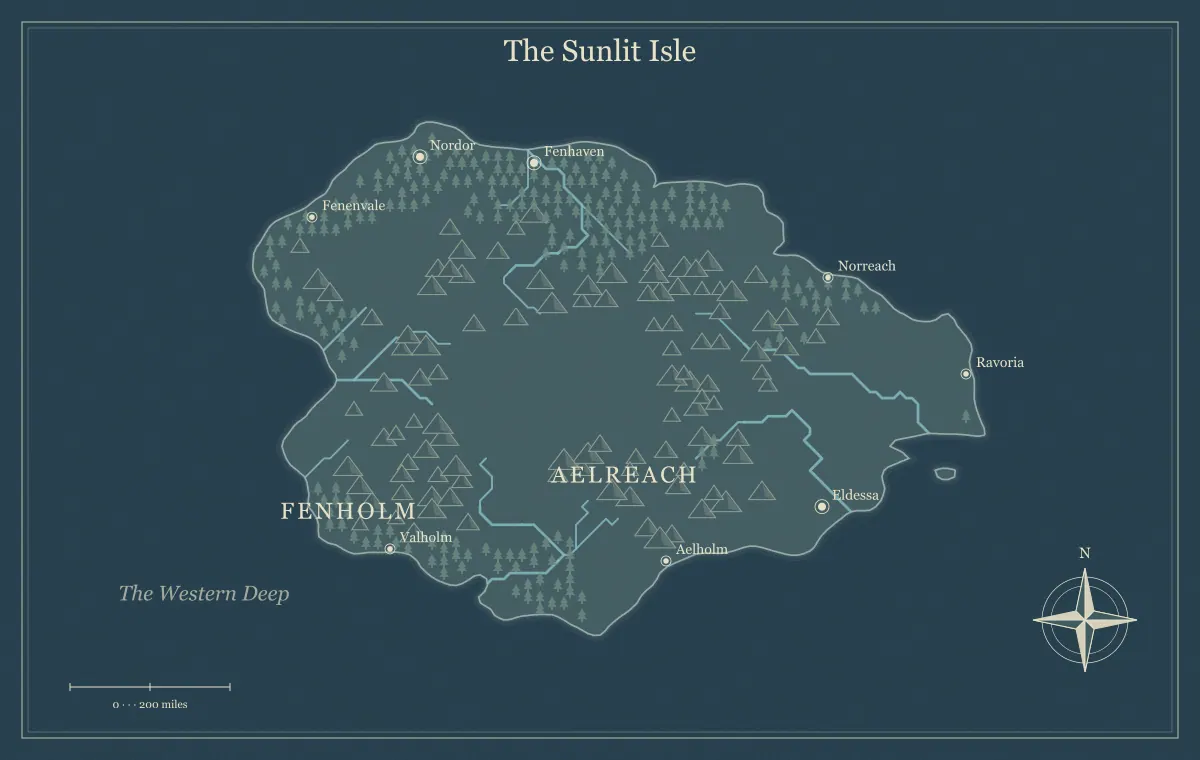
A hidden realm can create discovery on a fantasy map, but the word hidden needs a precise meaning. A place may be absent from a character's chart, concealed by terrain, restricted by an institution, or inaccessible under particular magical conditions. Those are different situations. If the explanation changes whenever the story needs a surprise, the geography can become arbitrary. A useful hidden place has stable physical relationships and a clear reason for limited knowledge or access.
This guide develops an original setting called the Hollow Lantern Valley using the fantasy map maker. The generator supplies fictional geographic illustration and supported edits, not a fog-of-war or access-control system. We will maintain author or game master information separately from a public map, establish how discovery works, and connect the concealed place to ordinary routes, resources, and residents.
Choose what kind of hidden place you mean
Write the category first. Hollow Lantern Valley exists beyond a ridge and is absent from the characters' public chart, but nearby residents know a trail into it. That is a difference in knowledge and access, not proof that the valley is invisible or uninhabited. A magically concealed island would need another explanation. Keep the categories separate even if more than one applies.
A place can also be known but difficult to reach. A remote archive may appear on the map while requiring an introduction or a specific route. The audience map guide provides a known, rumored, and private inventory, while magical geography helps define exceptions with consistent rules.
Identify whose map omits the place
A public trade chart may omit local trails because they do not serve its purpose. A character's sketch may contain only places they have visited. An official map may show claims but not every community. Decide the source and limitations of the artifact. An omission should tell you something about the map's viewpoint rather than silently become an objective fact about the whole world.
For Hollow Lantern, the characters begin with a road chart emphasizing the serviced pass. Their author or game master reference includes the valley and its local connection. The border guide explores viewpoint and authority, and novel planning separates author knowledge from narration. Keep that distinction stable when new information appears.
Establish the physical relationship first
Choose where the place sits relative to known terrain. Hollow Lantern lies in a side valley beyond the ridge, with one local trail and a longer approach from the north. Those relationships should remain coherent after discovery. The secret does not require the mountains or nearby towns to move when the characters learn the location.
The mountain guide connects valleys and passes to movement, while scale planning keeps scope consistent. If your project requires exact matching geometry across map levels, use a suitable workflow rather than assuming a newly generated regional map will automatically be a precise crop of an earlier world.
Decide what makes access limited
The local trail may require knowledge of landmarks, an introduction, or a season when the route is usable. A restricted building may require permission rather than a hidden path. A magical entrance may depend on conditions you define. Choose the limitation relevant to the story, then explain what someone could learn about it before trying to enter.
A useful limitation creates choices instead of simply refusing access until the outline allows it. The characters can seek a guide, use another route, negotiate, or wait. The travel guide compares effort, services, and uncertainty. Keep the stable constraint separate from a temporary condition that affects one attempt.
Give residents ordinary relationships
A concealed place can have people who understand it as home rather than mystery. Hollow Lantern's residents maintain the trail, exchange goods with a neighboring village, and use a local meeting ground. Their knowledge differs from the travelers' chart. This makes the place feel inhabited and avoids treating discovery by the protagonist as the beginning of its history.
Choose services, needs, and interests relevant to the project. The frontier settlement guide connects communities to water and routes, while city placement develops supply assumptions. A hidden place still needs a coherent relationship to resources, even if magical infrastructure changes the ordinary pattern.
Explain exchange without destroying concealment
If the valley receives tools or sends goods elsewhere, decide who handles the connection and what others know about it. A small group of regular carriers may know the trail while wider merchants recognize only a nearby transfer point. This can preserve limited public knowledge without pretending that an active settlement never interacts with the surrounding world.
The trade guide connects needs, transport, and transfer services. Keep the explanation proportional to the story. You do not need a complete secrecy apparatus for every shipment, but a major dependency should not vanish whenever someone asks how residents obtain ordinary supplies.
Provide evidence that supports discovery
Discovery can begin with an alias, a traveler, a route marker, or a relationship in a record. Choose evidence connected to the setting rather than one arbitrary clue that must be noticed exactly once. A local carrier may mention a meeting ground, while an older chart records a route no longer used publicly. Those pieces can lead toward the valley through different approaches.
Keep essential information obtainable if the story requires progress. Optional history can remain uncertain, but the audience needs a way to act. The landmark guide develops physical evidence of past use, and journey planning connects new information to changed decisions.
Distinguish rumors from precise geography
A rumor that a valley exists does not automatically reveal its exact location or route. Record the source, the useful fact, and the uncertainty. The public map can include a broad note or nearby reference without a precise private marker. This gives the audience a lead while preserving discovery.
Do not make every rumor unreliable merely to protect the secret. Some stable facts help people compare approaches and understand why a source matters. When a rumor is corrected, explain the new evidence. The knowledge inventory guide helps maintain those states. The map can evolve through learning without its physical facts becoming inconsistent.
Build a public version deliberately
Start with known geography and destinations, then add only information appropriate to the audience. Keep the concealed location out of the public branch when its exact position is private. A missing name does not hide a conspicuous icon. Also inspect the title, caption, and filename, since they can reveal what the map body omits.
The current tool does not provide a secure secret layer or an account-controlled fog system. Separate saved versions and ordinary file handling provide the information split. The audience version guide explains the release audit, and sharing links reminds you that a full settings link can disclose the edits it contains.
Give magical concealment a stable mechanism
If the place is magically hidden, define what changes: perception, route access, appearance, or the ability to enter. Decide where the effect applies and what sustains it. A valley whose entrance is obscured differs from one that physically moves. Those mechanisms have different consequences for residents, supplies, and outside knowledge.
The magic guide develops rules, limits, and maintenance. Keep the mechanism consistent enough that the audience can reason about discoveries. A surprising exception can enrich the setting, but it should not erase every previously established condition only to force a new plot direction.
Choose why knowledge became limited
A route may have lost public use, an institution may have restricted access, or a community may maintain a separate map tradition. Choose a history relevant to the present situation. Hollow Lantern's local trail remains useful after the public road network shifts south. The valley becomes unfamiliar to outsiders without becoming disconnected from all neighbors.
Record what survives: local names, old records, route signs, and agreements. The landmark guide connects past function to present evidence, while kingdom design explains how official claims can differ from practical services. A coherent history makes the omission meaningful.
Decide what discovery changes
When the characters find the valley, separate new knowledge from world changes. The valley already existed; the public map can now record it if that fits the audience's knowledge. The visit may also change relationships, access agreements, or attention from outside groups. Those are additional consequences, not automatic results of placing a new label.
The maintenance guide helps record those categories. For a novel, update the author reference and consider whether the reader map should remain limited to its initial viewpoint. Discovery becomes more meaningful when it affects choices while preserving the place's own history and residents.
Test Hollow Lantern through a carrier's journey
A carrier travels from the neighboring village to the valley with tools. They know a route marker and have an agreement with the residents. A traveler who meets them can learn that the valley exists, but not necessarily every path or private institution. This ordinary connection tests whether concealment and supply can coexist under the rules you established.
Now imagine the traveler seeks entry. They can ask for an introduction, investigate records, or explore another approach. Each option should have an understandable relationship to access. If the only answer is that the valley remains impossible to find until a predetermined scene, clarify the mechanism and available information. A coherent hidden place supports discovery through choices rather than arbitrary geography.
Keep a short Hollow Lantern discovery record
Before discovery, the public chart shows the ridge and neighboring village but no precise valley marker. After meeting the carrier, the characters know a community exists beyond the ridge and that an introduction may help. After traveling there, they know the landing or trail they actually used. Those are three different knowledge states, and the public map can reflect each without inventing a new physical valley at every stage.
Record the source beside each new fact. The carrier's report supports the lead; the journey supports the known approach; a resident's account may explain an alternative route that remains untested. This keeps certainty proportional to evidence within the fiction. It also gives you a useful answer when someone asks why the map marks one path confidently while another remains only a note or rumor.
Keep the reference and public files recoverable
Save editable JSON files and approved images with clear audience names. Preserve external edits separately if you use another application for custom geometry or symbols. The saving guide and export guide explain recovery and delivery checks. Browser storage should not be the only copy of a complex knowledge split.
A useful hidden realm has a clear physical relationship, limited knowledge or access, ordinary dependencies, and a meaningful discovery process. Hollow Lantern becomes a place the audience can investigate because its concealment follows rules. The map provides orientation, while deliberate viewpoint and access decisions preserve mystery without making the world impossible to understand.
Give the idea a world of its own.
Try the technique in the generator, then save an editable copy so you can return to your work.
Open the map maker ↗