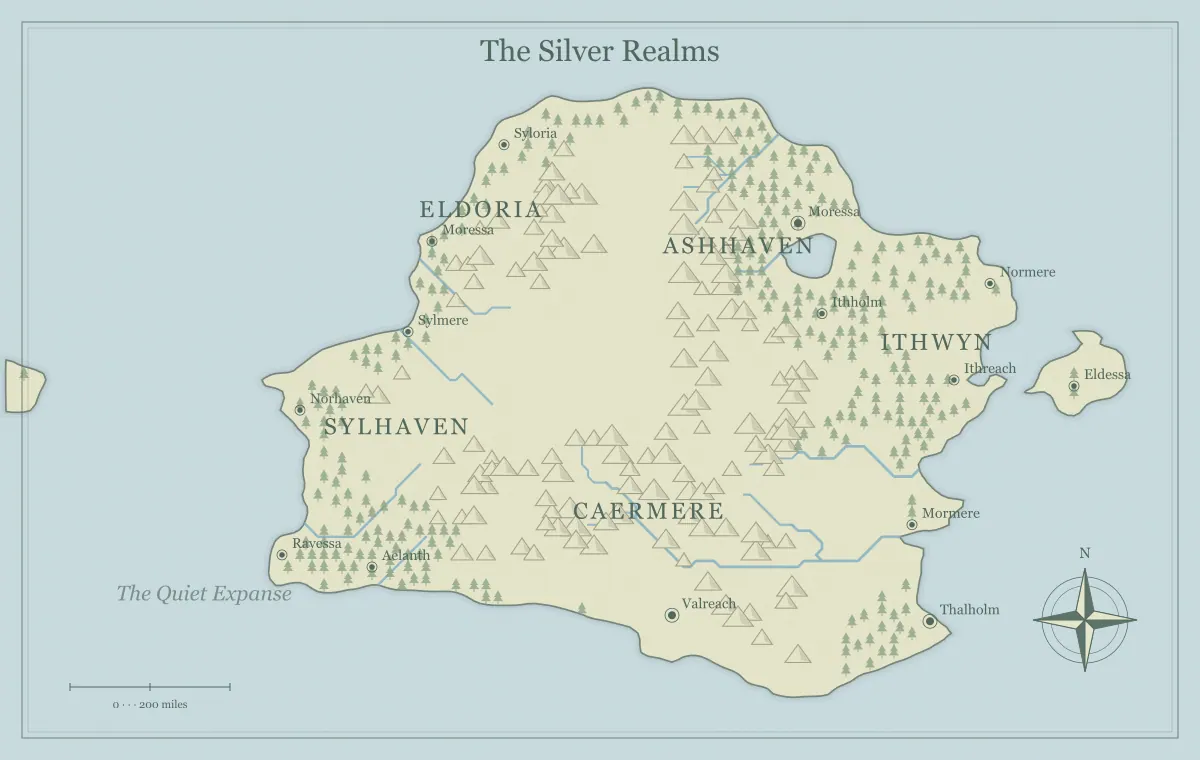
A map can help organize a character's journey without turning the story into a fixed itinerary. Geography creates opportunities and constraints, but the character's goals, knowledge, and relationships determine what those features mean. A bridge is not automatically an obstacle, and a distant city is not automatically a climax. The useful question is how a place changes the choices available to the character at a particular moment.
This guide follows an original story about a courier named Ilen traveling through the Ember Vale to a coastal records house. Use the fantasy map maker for a geographic reference, then keep the narrative decisions in your scene notes. The generator supplies fictional terrain rather than a plot system. We will connect physical movement to motives, information, and consequences while leaving room to revise the journey as the draft develops.
Separate the destination from the underlying goal
Ilen's physical destination is the records house. The underlying goal is preserving evidence that may change a family's future. Those are related but different. Reaching the building does not guarantee success, and a discovery along the route may change what success means. Write both goals before choosing every stopping place, so the map serves the story's stakes rather than becoming a checklist of locations.
The same distinction works for a campaign character seeking an ally or a traveler trying to return home. The route matters because of the goal attached to it. The novel map guide connects geography to draft questions, while the workflow guide helps choose an appropriate geographic scope.
Establish the character's starting knowledge and resources
A route choice depends on what the character knows and can use. Ilen has a public road chart, limited money, and a contact near the river landing. They have heard of a ridge trail but do not know its current condition. These facts make the initial choice understandable. Another character with a boat or a different relationship could reasonably choose another route through the same geography.
Keep starting knowledge distinct from author knowledge. Your reference may show the full network while the viewpoint character sees only part of it. The audience version guide provides a useful known, rumored, and private inventory. That distinction protects discovery and prevents narration from casually revealing a route the character has no reason to know.
Offer alternatives with narrative consequences
The official road provides services and predictable directions but passes a checkpoint. The river connection requires a boat and reaches a different community. The ridge trail avoids public attention but depends on local guidance. These differences can change information, relationships, and timing. A route should do more than provide a new scenic backdrop if it occupies significant story space.
The travel route guide explains practical tradeoffs, and scale planning separates distance from elapsed time. Apply those ideas to the character's priorities. A safer route may be unattractive if it exposes evidence to inspection, while a slower route may become worthwhile because it reaches a trusted person.
Give each important stop a reason to enter the story
Choose stops through decisions and consequences. The river landing offers transport but introduces someone with conflicting information. The ridge settlement can provide guidance but asks for help. The records house presents the final access problem. Each place changes what Ilen can do or understand. An extra town that changes nothing may need less narrative attention even if it remains on the world map.
Write a short location note with the character's immediate purpose, complication, and possible result. The city placement guide makes the settlement's ordinary role coherent, while landmarks gives a nonurban site history and function. The narrative role and geographic role can reinforce one another without being identical.
Make obstacles change a decision
A closed crossing is useful when it forces a meaningful response. Ilen may wait, seek another route, negotiate passage, or reconsider the deadline. If every obstacle only delays the same inevitable path, travel can feel repetitive. Choose constraints that reveal priorities or create consequences the later story remembers. The obstacle's source should fit the geography or established institutions.
A damaged landing can follow from a local maintenance problem, while a checkpoint can reflect political authority. Do not invent a completely new rule at each location solely to block progress. The border guide and river guide help connect constraints to the setting. A coherent problem gives the character something to reason about rather than only endure.
Let new information alter the route
At the river landing, Ilen learns that the records house has moved its public entrance and that a local guide knows an alternative approach. The destination remains, but the plan changes. This is a knowledge development, not a reason to redraw the coastline. Keep track of who provides the information, why the character trusts it, and what remains uncertain.
New information can complicate a choice without making every source unreliable. Stable facts help readers understand the world, while selective uncertainty creates discovery. The hidden realm guide distinguishes unknown, concealed, and inaccessible places. Use those categories when a route or destination is absent from the character's original chart.
Keep elapsed time connected to actions
A journey's duration includes travel, rest, waiting, investigation, and chosen detours. Record the causes that matter to the plot. If Ilen misses a deadline because they stopped to help someone, the delay expresses a choice. If a boat is unavailable, the timing depends on a practical condition. The map alone does not determine every hour between scenes.
Use precise estimates only where they affect the story, and apply consistent assumptions. The scale guide provides a simple planning framework. A magical transport exception can work if its role is established, but it should not appear only to repair an unexplained timeline contradiction. Keep the physical distance and the narrative decision about what to show separate.
Decide which movement needs a scene
Not every mile deserves equal narrative space. A familiar stretch of road can be summarized, while a crossing that changes the character's plan may need a scene. Use the map to identify transitions and opportunities, then choose the pacing according to what develops. The illustration can contain places that never receive a full chapter.
A useful outline distinguishes travel information from dramatic action. “Ilen reaches the landing after a day on the road” is orientation. Negotiating for a boat while protecting the evidence is a scene with a decision. Keeping those functions distinct helps the map support pacing without flattening every geographic feature into the same narrative weight.
Use geography to reveal priorities without dictating personality
A character's response to terrain can reveal values. Ilen may choose the river because they trust the contact, not because every courier would prefer boats. Another traveler may use the official road despite inspection because reliable shelter matters more. The same setting can support different meaningful choices. Avoid assuming that one landscape automatically produces one kind of person.
Connect preferences to established experience, resources, and relationships. A feared pass may be familiar to someone raised nearby. A busy port may feel secure to one character and exposed to another. The settlement guide and forest guide help give places ordinary lives beyond the protagonist's impression.
Let earlier choices affect later places
A contact helped at the landing can provide an introduction near the coast. A delay can change who is present at the records house. A route chosen to avoid inspection can limit access to a public service later. These consequences connect the journey as a network of decisions rather than a sequence of unrelated encounters.
Record only the consequences the story uses. You do not need a complete branching simulation for every possibility. The trade guide explains ordinary dependencies, while kingdom design connects institutions and routes. Those setting relationships can provide believable reasons for a choice in one place to matter elsewhere.
Use return journeys to show change
A return through the same geography can reveal a changed character, relationship, or world condition. Ilen may recognize a route previously dismissed, use a new introduction, or see the consequences of a repaired landing. The terrain does not need to become different for the journey's meaning to change. Repeated places can gain depth through new knowledge and experience.
Keep physical changes separate from changed perception. The maintenance guide offers a useful classification even for novel planning. A reopened road is a world change; understanding why a community maintains it is a knowledge change. Recording the distinction keeps the map and narrative coherent across revisits.
Test one Ember Vale route decision in a scene
At the landing, Ilen sees a cargo crew unloading while the public ferry waits for repairs. The contact can arrange passage on the cargo boat, but it stops at a different coastal quay. That option saves waiting and changes the approach to the records house. Ilen must compare the deadline with the risk of arriving through an unfamiliar district. The scene uses the route network to present a decision grounded in the setting.
After choosing, record what the decision changes: the arrival point, the person accompanying Ilen, and the information available along the way. You do not need to add another arbitrary obstacle immediately. The consequences already create material for later scenes. If the route choice produces no difference beyond a new landscape description, decide whether it deserves this much narrative attention or whether a shorter transition would serve the draft better.
Prepare the reader's map for its role
A public illustration should orient readers at the point where they encounter it. It may show early destinations and broad regions while omitting late reveals. Check labels, markers, title, caption, and filename for unintended spoilers. Keep the author reference separate so removing information from the public version does not erase useful planning detail.
The audience version guide and final review support that audit. Test the exported image at its actual placement size using the export guide. The reader map should help follow the story without pretending to contain every fact the author knows.
Revise the journey and map together
When a chapter changes, ask whether its geography, knowledge, or timing assumptions also change. Save a baseline before major revisions and update the name register consistently. A local label correction is different from moving a destination or replacing the route network. Record the reason for substantial changes so later drafts do not silently disagree.
Use the saving guide and notebook guide to keep the reference recoverable. A character's journey becomes compelling through motives, decisions, information, and consequences. The map can make those relationships clearer while leaving the narrative flexible enough to grow beyond the first route you imagined.
Give the idea a world of its own.
Try the technique in the generator, then save an editable copy so you can return to your work.
Open the map maker ↗